
Thoughts from the curator of the Land art Symposium Borderland Space. From the middle of art situation in Mohrytsia environment, Sumy region, Ukraine.
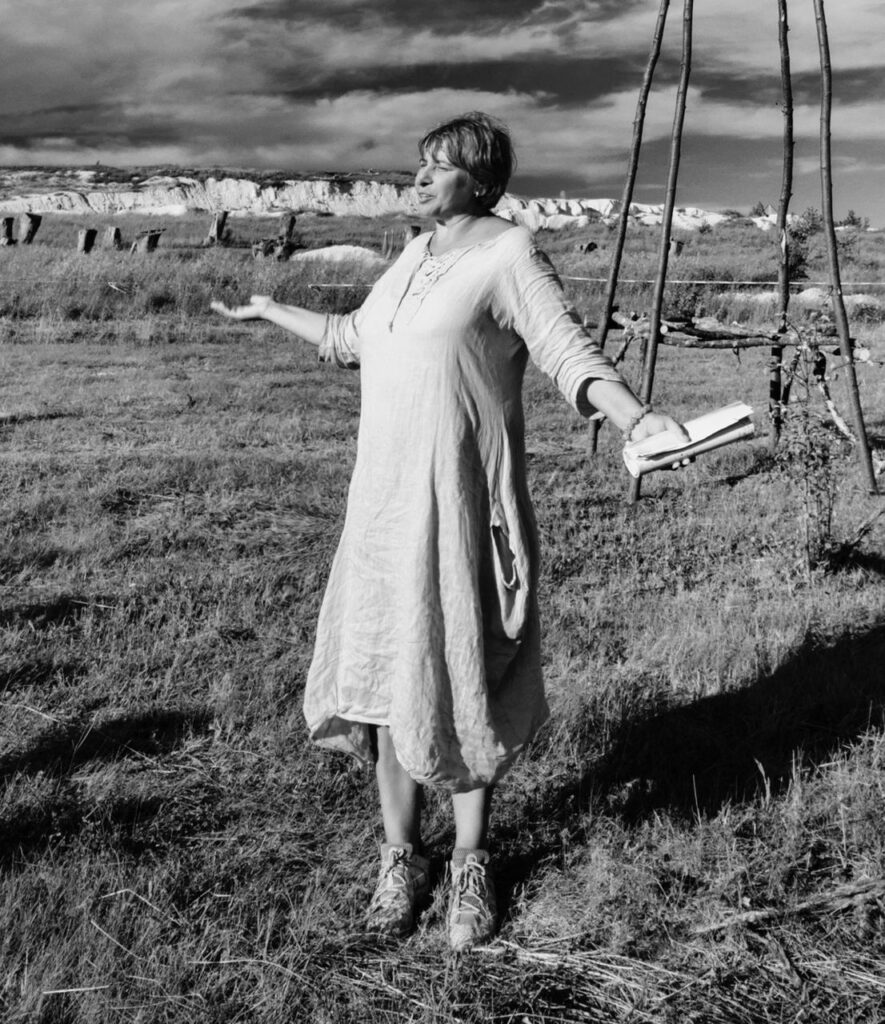
Ganna Gidora, founder, curator of the land-art symposium Borderland space
Why here and at this time (to be honest)?
When I speak about Mohrytsia, I want to take people by the hands and lead them to the highest place in the Mohrytsia settlement, because from there the panorama of the floodplain of the River Psyol reaches tens of kilometers, and the landscape fills the body with the spirit of a bird.
And also — because of the complexity of the relief, the swiftness of the slopes (inaccessible for grazing) — a kind of reserve for forbs has developed here. It is at the end of June, on the solstice, lush greenery lights up with picturesque diversity. And among this crazy play of colors there are tablecloths of the white naked interior of the earth — the chalk. The heart is tenderly aching with joy. And nearby there is my grandparents’ hut. As a little girl, during the peak of summer, my grandfather would put me on a cart and take me to the hills to mow the hay. I still do not understand what he needed a small child for in such a heat. Perhaps only years later I wanted to share this beauty with the whole world. And not for no reason, after visiting Mohrytsia’s spaces, I feel as though I have received news from childhood.
Why land art?
You take the canvas — and with a wide brush paint from edge to edge. This is an etude. This place. You seem to be with it, but more with what is called, in professional terms, the picture plane. And when you wander enchantedly in the rustle of herbs, inhale the fragrant breath of the dense space, your gaze wanders between the boundless versatility of the immense beyond — you want to be a particle, you want to weave your sign. The environment becomes an aesthetic substance, which the artist comprehends, creating an artistic image.
Why again and again?
The picturesque chalk plateau between the string of boundary settlements of the Severskiy lands annually demonstrates the result of the creative investigations of several dozen united artists, within the framework of Ukraine’s first land art symposium.
And each of us, from the first day of arrival, again peers into the night’s sky.
What if the stars fall all together?
– And the settlement whispers with memories of someone’s love and someone’s tears.
– Did they also take each other’s hands, and roll down to the river in the coveted coolness of the water?
And when feelings overflow, one wants magical actions, thoughtful, unhurried — because this is what the place wants.
Every year, when the morning mist covers the whole white world, the artists, who, awaiting the fog, sit on the mountain as if on an island, act with this ocean, or maybe sail, and…
The number of works in the environment grows, every year more and more.
And a year later we come again — this is how years are measured, by Mohrytsia.
And what does all this mean for the environment?
Of course, it was, is, and will be.
Majestic, dreamy, charming.
Last year’s objects dissolve into space, and when you return to a new summer, you notice traces with your eyes — symbols of works next to 8th–10th century pieces of ceramics.
In the days of creating the environment. Paths.
“We weave into the existing context of the environment, it is a desire to understand one’s place in it,” says Petro Bevza, our Ukrainian theorist of environmental art.
But each of the artists feels his place in the environment in his own way. Everyone has his own path. Almost all paths on our land look like light towels. A white canvas flows down the road from the chalk wall. And if you walk along it to a white massif of rocks, it is lost among the haze of dazzling white chalky soil, as if it dissolves in the linen of the beginning of eternal existence.
And in the meadow, the water left its paths on its own, having crossed out the cyclically-spherically old channels on the half-bay. Nature itself has created an exquisite work of art. You sit on a high princely settlement in the spikelets of grass, peering into the curves of the old woman. Sometimes the wind blows. The night wind carries the human voice and the moans of cattle. The steppe breathes with changing anxiety, and the warm earth of the hill behind you smells like milk and home. And here follows the road of fog due to the bend of the forest in dawn witchcraft, you take it with your hands, you wash yourself with it …
And next to it is a river with a white background of a chalk bottom under a veil of transparent water — isn’t time expensive?
And so, wandering in the neighborhood, between these symbols that have appeared (or maybe they have always been?), you listen to the sound of white, that structural color of the chalky quarry, glowing with unreal purity. You feel that the wind, which has always been nearby, left shadows.
SYMPOSIUM of land art in Mohrytsia.
What is this all about and for?
Yevheniia Moliar, an art expert
From 23 June to 2 July, the 21st International Land Art Symposium “Borderland Space” was held in the village of Mohrytsia (the Sumy Region). Art expert Yevheniia Moliar talks about the works presented at this year’s festival, characterized by a new, caring attitude to the landscape, ironic artistic expressions and interaction with local residents.
“I first got to Mohrytsia in the early 2000s. I don’t remember the year exactly. Once, we all tried to remember, but I think it’s not crucial. At that time, I came to visit my friends who studied at the Sumy School of Culture and used to come to Mohrytsia for the plein-air. It is from the student plein-air that this symposium originates. Now, I visit Mohrytsia every year. Over this time, the symposium has become so dear to me, that I cannot be unbiased in my observations and reflections. However, I will try to tell about the special thing that is manifested in the 21st “Borderland Space.”
“I think, today, it is somewhat inappropriate to single out land art as an artistic category or direction since modern art mostly does not operate with such concepts, it gets universalized. However, it is important to talk about the Mohrytsia Symposium as a separate artistic phenomenon that is constantly changing. I remember, at the very beginning of the 2000s, the art of ritualized action in the environment prevailed here. Fire, movement, ritual… Eventually, the action was replaced by a sign; and the art became minimalist, elegant, and geometric. The symposium experienced moments of crisis, connected with the need for development, expansion and improvement. For example, in 2013, the symposium was held in an experimental festival format, with music, shows and spectacular art. It seemed it was the end as if the fragile borders of the unique Mohrytsia space could not withstand publicity. Nevertheless, even after something like that, the symposium revived, it did not lose its uniqueness. On the contrary, it seemed that everyone began to appreciate and protect the intimacy of this phenomenon even more.
“What innovations happened to the “Borderland Space” this year? First, the crowdfunding! Part of the symposium funding was raised on bigggidea.com. The main organizational costs are the reimbursement of the participants’ travel expenses, hospitality and the purchase of art materials. Besides, the organizational structure of the symposium was transformed. Anna Gidora, the constant leader and inspirer of Mohrytsia, is always happy to delegate her powers to new participants. Now, all the artists were divided into 8 conditional curatorial groups, which seemed to me to be more important for the formal organization of the work than for the conceptual one. Stanislav Turina brilliantly moderated the symposium. Vitaliy Kokhan traditionally headed the coordination of artistic production. Yuriy Vyshniakov was the administrative director once again. The artists identified a number of important issues that made up the agenda, or rather the night’s agenda, for traditional gatherings around the fire and joint discussions.
“The general theme of the symposium was the “Formula of the Horizon,” which changed somewhat during the work, and post facto I would define the “Formula of the Untouched Horizon” as a common theme for the symposium. Perhaps, it was for the first time, that I observed the triumph of a common idea, which consisted not only of general non-interference in the landscape, but also of the desire to reproduce it, in Mohrytsia. The artists consciously avoided manipulations with the environment (digging, burning, mowing, etc.). To work with the landscape, Lucy Ivanova resorted to an optical illusion — “A Person Who Sat Down to Breakfast and Noticed the Horizon.” Noting the consumerist nature of working with the environment, on one of the most picturesque hills, Lucy installed a dining table with a chair, sitting in which, through the lens of tableware, one could observe the transformation of the landscape. Tetiana Borychok complemented the landscape with bodily practices (“Balancing”). As part of Ilya Novgorodov’s performance “Big Cleaning Up” or “Chasing Dust Away,” the artists (Ilya Novgorodov, Iurii Shtaida, Nadiia Bilokur, Oles Tomakh, Roman Lynnyk, Roksolana Uhryniuk, Marina Fenota) took up the task of cleaning the quarry from garbage and art remnants. Among such a careful attitude to the landscape, Volt Agapeyev’s work “Schism” with a hole dug in one of the hills of Mohrytsia stood out. What was here before — digging, carving, etc. — now looked extremely inappropriate in the general retentive context. “Leave it Wherever You Want,” a project by Vitalii Protosenia is an unfinished action in space. The author tried to make a large-scale work, for which it was necessary to move a large amount of chalk stone from one place to another with the involvement of special equipment. In the process of work, such a radical intervention in the landscape was re-thought. The author abandoned his idea in the process and called it the words of a tractor driver who was unloading an already unnecessary mountain of chalk stone on a hill.
“Several objects were dedicated to individual (“Miracle” by Kostiantyn Zorkin) and collective (“Ward” by Sasha Dolhyi) and contemplation of the horizon. Direct action of collective contemplation are “Etudes for the Landscape” (participants: Yehor Antsyhin, Katya Buchatska, Olena Volynska, Vira Hanzha, Mariana Holembiovska, Yuri Yefanov, Lucy Ivanova, Sviatoslav Koverzniev, Yevhen Korshunov, Katya Libkind, Natalia Matsenko, Violetta Terlyha).
“In addition to visual perception, the artists aimed for a more empathetic experience of the environment by taking collective walks. Attila Hazhlinski observed the area on the horizon for several days from the specified place — “A Small Shop-Window” until he went there with a tent to live for a while.
“This focus on the surrounding landscape preservation was emphasized by several acts of museumfication in the environment. The “Open Group” created an “Open Gallery” on a remote hill by setting up a granite board with a detailed landscape description. Yehor Antsyhin carried out cataloguing and publication of all the inhabitants of the Mohrytsia ecosystem — birds, insects, reptiles — by writing down all their names with a piece of chalk on a board installed in the meadow — “A Temporary List.” “Hedera Museum” by Yuriy Biley is planting a seedling of museum ivy from Wroclaw. On the eve of this year’s symposium, Anna Gidora and Sumy City Council deputy Yevhen Kosianenko saved from destruction, in the context of “improvement,” concrete mosaic sculptures that once decorated one of the city parks in Sumy. At the request of Gidora, they were transported to Mohrytsia and installed among the objects of the symposium. Thus, they were saved from falling into the landfill and actualized as part of the cultural and sculptural heritage. The museum ivy that will now entwine the mosaics will symbolically protect them from “improvements.”
“The theme of feasibility of “development and improvement” became important for the entire symposium, and in particular for the “DE NE DE” initiative. In the context of preserving the artistic heritage of the Soviet period in public space, we are constantly faced with the fact that gentrification processes are detrimental to any form of preservation. Discussing the various forms of urban activism that always prioritize development, we are increasingly convinced that sometimes it is more important to nurture sustainability and decline as keys to preserving existing values in the pursuit of renewal.
“The uniqueness of the Mohrytsia symposium is its specific artistic context, which has been formed over two decades by various artists. Certain artistic patterns form the figurative language of the borderland space. The question of repetition or similarity of works of art is often discussed here, and mostly with negative connotations. This is what defines the Mohrytsia symposium as a complete artistic phenomenon.
“In Mohrytsia, barefoot performance artists will always walk slowly, mow or trample majestic spirals, lay stones in the quarry and construct white triangles on green slopes. This is how an environment for environmental art is formed, as well as a discourse in which new meanings are generated. Vasyl Kostyniuk aptly noted this in his work “Surface Tension” — a white cube in the air above the river, touching one corner of the water, drawing attention to the simple and understandable that lies on the surface but is devalued in the pursuit of development.
“This year, there were many ironic witty projects. Rodion Prokhorenko’s “Observation Platform for the Performance that I Did Last Year” jokingly updates the issue of the presence of an audience for art in the environment and methods of mediated representation. Last year, the artist marked the place of presentation of his performance at a very long distance from the action itself. Spectators could watch something happening in the distance but could not see what it was. This year, the author installed an optical device at the presentation site aimed at the place of action, which now turned out to be empty. Oksana Solop’s humorous “Video-selfie,” where she looks into the horizon in search of inspiration, doubling the Mohrytsia landscape in the reflection of her glasses. “Mr. Chalk Stone” by Yuliia Makarenko and Oleksii Romanenko is a simple object created as a result of the considerable production skill of the artists. Continuing the theme of physical labour in land art — an eternal source for Mohrytsia memes, which was developed last year by Stas Turina and Lubov Malikova (performed meaningless actions, not oriented to the result). Creating art in the environment often requires hard work, while the environment in which it takes place seems to encourage rest — a campsite, attractive landscapes, a river… This year, digging was already as if out of place, as the landscape became untouched, and the shovel turned into a medium. “First Digging, then Love” — Yevhen Korshunov installed a great 4-meter shovel on a slope above the river. Tymofii Osypov created the sculptural composition “Unfinished Action” from shovels, the handles of which emphasized the lines of the chalk quarry.
“An extremely important progress this year was the interpenetration of the village and the symposium in numerous projects. “Open Group” consistently worked with the local population every evening. The result was a joint artistic action with the residents of the village of Mohrytsia “House of Culture,” which was embodied in illuminating the House of Culture building with flashlights late at night. By the way, a very interesting conversation happened between the artist Oleksii Konoshenko and the director of the village house of culture. The director first noted that artists often visit the local store next to her institution. “What is going on in your house of culture?” asked Oleksii. “Nothing,” the woman answered immediately. Several times Konoshenko repeated his question in different ways, and the head of the local cultural institution stubbornly denied any of her activities. Viktoria Zymomria recorded a short monologue of Mr. Mykola from Mohrytsia “A Difficult Question — a Simple Answer.” The recording was played every day in the common space of the symposium. “To work, to work, and to work…” the voice repeated like a mantra, as the author noted. Mohrytsia acquired a topical sound in Tomash Hazhlinski’s work “Reading the Landscape of the Quarry.” Tomash turned the outlines of the chalk quarry into music with the participation of Katya Buchatska.
“Urban practices brought into environmental art were eloquent. The DIS/OR-DER group built a fence in an open space from materials found in the village and at a local dump. The artists marked the horizon with the work “Whose Fence?” and dedicated it to the problem of pogroms of Roma settlements in Ukraine. Violetta Terlyha and Vika Teletien built a fragment of a wall made of silver bricks, on which Volt Agapeyev’s graffiti soon appeared. Leo Trotsenko performed “Ideological Sketch No. 1” by painting white chalk puddles with # жовтоблакить (blue and yellow).
“In total, more than 30 art projects were presented here in two weeks. The artists created a voluminous, ironic, critical and self-reflective statement about art in the environment in general and about the Mohrytsia symposium in particular. For the most part, it is a site-specific object made of natural materials in the environment. Some of them will remain there forever. Some will be dismantled. Also ahead is the interpretation of this year’s special “Borderland Space” — the best one, like all the twenty previous ones.”